Taiwan Dong Ding review: a greener cup than the name may suggest
This Dong Ding is for someone who enjoys a green, vegetal oolong with a buttery edge. It is not the obvious choice for a drinker expecting a deeply toasted Taiwanese tea. The strongest buying question is whether its leafy character sounds refreshing or simply less floral than you want.
We may earn a commission if you buy through our links. Affiliate disclosure.
At a Glance
KEY FEATURES
- Green-style Dong Ding
- Qingxin / Chin Shin
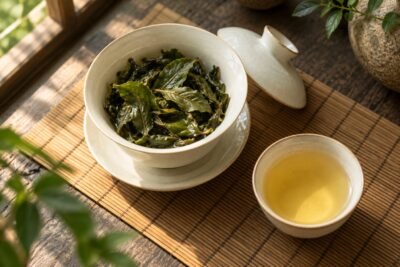
- Cup: 5 g / 355 mL / 100°C (212°F) / 3–5 min
Tea assessment
Research-based editorial fit scores, not personal testing or measured intensity. Historical customer experiences may differ from the current batch.
Best fit is leafy and buttery, rather than strongly floral or roasted.
Body and lingering finish are meaningful strengths.
Large opening leaves and dose sensitivity require attention.
Fading and later bitterness limit the seven-infusion expectation.
PROS
- Vegetal character can appeal to green-tea drinkers.
- Body and aftertaste can outlast a modest aroma.
CONS
- Floral expectations often exceed the cup.
- Longer sessions may become bitter or one-dimensional.
- Large opened leaves can crowd a small gaiwan.
Which Dong Ding are you expecting?
TeaVivre sells a green-style Dong Ding and a separate moderately roasted version. This review concerns the green-style listing. That distinction answers the first purchase question: adding more leaf will not turn this tea into the toasted Dong Ding you may remember from another seller.
For a leafy, buttery cup
Original accounts describe spinach- or squash-like impressions, sometimes with a substantial mouthfeel and lingering finish. A green-tea drinker who enjoys that savory direction has a concrete reason to sample it.
For toast or prominent flowers
Several accounts wanted more roast or a more floral cup. Those are preference mismatches, not problems that necessarily disappear with a stronger infusion. The moderately roasted Dong Ding is a different product to consider.
The large leaves complicate a “just add more” adjustment
The feedback contains both a desire for more strength and a practical warning about crowding: the listed seven-gram gongfu portion can expand enough to be difficult to keep submerged in a 110 mL vessel. Combining those observations gives a more useful recommendation than simply increasing the dose. Leave working space for the opened leaf, and treat a changed vessel or dose as a new preparation to evaluate.
Prepare the green-style listing on its own terms
Cup
5 g / 355 mL / 100°C (212°F) / 3–5 min. Decant at the chosen time. The cup instructions do not specify a rinse.
Gongfu
7 g / 110 mL / 100°C (212°F). Approximately 5 seconds. Infusion sequence: 20, 30, 35, 45, 55, 70, 90 seconds. Drain fully between pours.
The standard Dong Ding product page supplies this recipe. In your first session, check whether later infusions retain the buttery body or become mainly vegetal, bitter or faint. The source accounts disagree about that progression; a six-pour schedule does not resolve it.
If your actual choice is between two green oolongs, compare this Dong Ding with standard Tie Guan Yin. For a roast change, use the Dong Ding guide’s separate recipes rather than applying this schedule to the moderately roasted tea.
Pros & Cons Analysis
Based on supplied customer reviews and verified product documentation
Pros
- A leafy, buttery direction gives this tea a role between a green-tea routine and a rolled-oolong session. It makes more sense for that preference than for someone who wants a forceful charcoal or caramel aroma.
- Positive accounts distinguish a substantial mouthfeel and lingering sweetness from the comparatively quiet fragrance. Evaluate the finish as well as the first aromatic impression.
Cons
- Several accounts describe flowers on the leaves but mainly vegetables in the infusion. A higher dose does not guarantee the floral balance the drinker wanted.
- Fading by the third or fourth infusion and later bitterness both occur in the sample. Stop on taste rather than completing all seven listed infusions regardless.
- A detailed account finds the listed seven-gram portion difficult to keep submerged after the leaves expand in a 110 mL vessel. Choose adequate working space rather than compressing more leaf to chase a stronger flavor.
Our verdict
Choose this Dong Ding for a green, buttery cup and enough body to make a quiet session satisfying. If you want caramelized warmth, start with the separately reviewed moderately roasted Dong Ding. If pronounced flowers are essential, sample before buying a larger bag.
Frequently Asked Questions
Is this the moderately roasted Dong Ding?
No. TeaVivre sells a separate moderately roasted listing with its own recipe and customer evidence.
Why does my cup taste more green than floral?
That balance appears in the original feedback. Preparation can change concentration, but it does not guarantee a different underlying flavor profile.
Tea details
| Tea style | Green-style Dong Ding |
|---|---|
| Seller-stated origin | Dongding, Lugu Township, Nantou, Taiwan |
| Cultivar | Qingxin / Chin Shin |
| Listed harvest | May 18, 2026 |
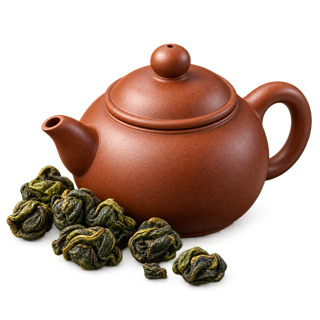
| Leaf form | Rolled balls |
| Added flavoring | Not independently verified; aroma names are not ingredient declarations |
| Cup leaf weight | 5 g |
| Cup water volume | 355 mL |
| Water temperature | 100°C / 212°F |
| Cup infusion time | 3–5 min |
| Gongfu leaf weight | 7 g |
| Gongfu water volume | 110 mL |
| Gongfu rinse | Approximately 5 seconds |
| Gongfu infusion sequence | 20, 30, 35, 45, 55, 70, 90 seconds |
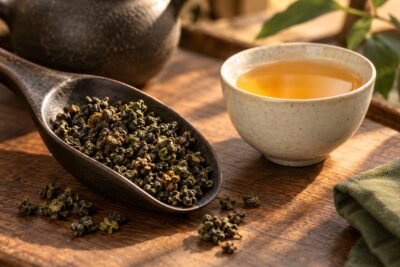
Superfine Taiwan Moderately-Roasted Dong Ding Oolong Tea
Dongding, Lugu Township, Nantou, Taiwan · May 18, 2026
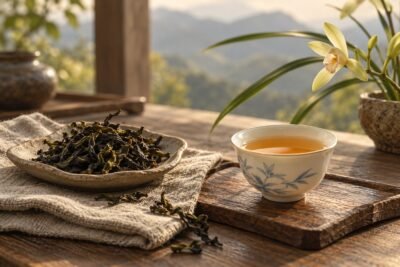
Huang Guanyin (Yellow Goddess) Wuyi Rock Oolong Tea
Xiaoqiao, Jian’ou, Fujian, China · April 30, 2026
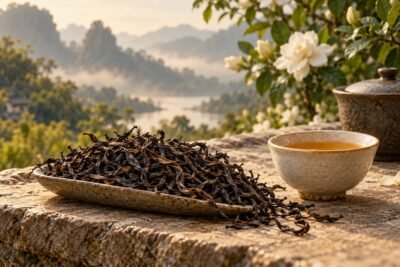
Ya Shi Xiang Phoenix Dan Cong Oolong Tea
Pingkengtou Village, Fenghuang, Guangdong, China · May 18, 2026
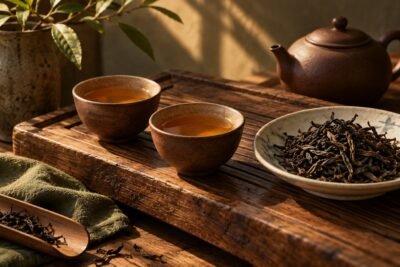
Nonpareil Wudong Song Zhong Phoenix Dan Cong Oolong Tea
Wudong Village, Fenghuang, Chaozhou, Guangdong, China · May 18, 2026