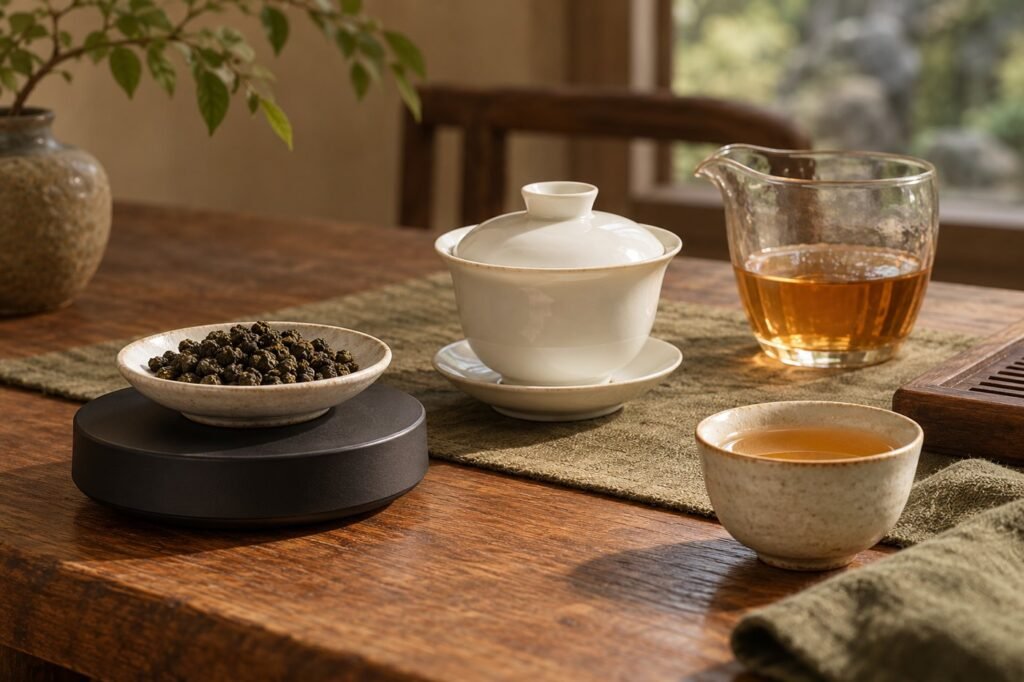
Check which Dong Ding you have before starting. TeaVivre’s standard Taiwan Dong Ding and its moderately roasted Dong Ding share a cup dose, but their gongfu sequences differ. The greener listing can remain vegetal even when brewed stronger; the roasted one is a different product, not a timing adjustment.
The simple cup route
| Listing | Cup method |
|---|---|
| Taiwan Dong Ding (Tung Ting) Oolong Tea | 5 g / 355 mL / 100°C (212°F) / 3–5 min |
| Superfine Taiwan Moderately-Roasted Dong Ding Oolong Tea | 5 g / 355 mL / 100°C (212°F) / 3–5 min |
- Use a heatproof vessel with an infuser roomy enough for the rolled leaves to expand.
- Weigh five grams and add 355 mL of water at the listed temperature. Start a timer.
- Begin at three minutes, then separate the liquor from the leaves completely.
- Taste before choosing a longer time on the next measured trial. Record which exact Dong Ding you used.
These are merchant starting recipes, available in the standard Dong Ding review and moderately roasted review. The customer evidence suggests different flavor preferences, not a rule that one needs to be forced stronger.
Keep the gongfu schedules separate
| Listing | Leaf / water / heat | Infusions after the rinse |
|---|---|---|
| Taiwan Dong Ding (Tung Ting) Oolong Tea | 7 g / 110 mL / 100°C (212°F) | 20, 30, 35, 45, 55, 70, 90 seconds |
| Superfine Taiwan Moderately-Roasted Dong Ding Oolong Tea | 7 g / 110 mL / 100°C (212°F) | 20, 30, 40, 50, 70, 90, 120 seconds |
Both listings specify an approximately five-second rinse. Have the pitcher ready before adding water and pour out fully after each timed infusion. Do not count the rinse as one of the seven drinking infusions.
Respond to the cup you actually made
| What you notice | Next useful action |
|---|---|
| Green Dong Ding tastes vegetal rather than floral | Decide whether you like that profile before increasing the dose; this balance appears in its customer evidence. |
| Opened leaves crowd the gaiwan | Use a vessel with enough working space, or scale both leaf and water together for a deliberate smaller batch. |
| Roasted Dong Ding starts quietly | Taste the next short pour before assuming the tea needs a larger dose; a developing second and third infusion is reported. |
| Only bitterness or a dull base remains | Stop the session. Seven listed pours do not require seven cups. |
Choose the version whose underlying character appeals, then refine one preparation. Brewing can change concentration; it cannot make the standard green-style listing into the moderately roasted product.