Huang Guanyin review: fragrance across a roasted cup
Huang Guanyin is worth sampling when aroma matters as much as strength. Original feedback describes flowers, apricot-like fruit and cocoa-like roast, sometimes with a creamy texture. It is not reliably a light-roast escape: other accounts find pronounced charcoal or a cup that becomes drying when pushed.
We may earn a commission if you buy through our links. Affiliate disclosure.
At a Glance
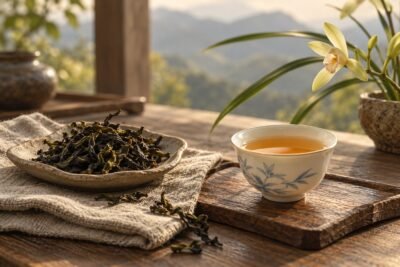
KEY FEATURES
- Huang Guanyin roasted oolong
- Huang Guanyin
- Cup: 5 g / 355 mL / 100°C (212°F) / 3–5 min
Tea assessment
Research-based editorial fit scores, not personal testing or measured intensity. Historical customer experiences may differ from the current batch.
Complex fragrance gives this a clear aroma-focused role.
Sweet and creamy reports coexist with later dryness.
Concentration increases can add astringency rather than detail.
Changing aroma is supported, with no uniform endurance result.
PROS
- Floral and fruit fragrance can carry the session.
- Sweetness and a creamy finish can balance toast.
CONS
- The roast may feel stronger than the description suggests.
- More leaf can add dryness without adding interest.
Would fragrance make a quieter taste worthwhile?
Huang Guanyin’s clearest attraction in the original feedback is aroma: orchids, apricot-like fruit and cocoa-like roast recur in descriptions, while some accounts find the immediate taste less remarkable. If smelling the lid and following the finish are parts of a tea session you enjoy, that can be a worthwhile tradeoff. If you mainly want a forceful sip, aromatic complexity may not compensate.
The word “light” does not settle its roast level for you
Some drinkers describe this as a bridge from lighter oolongs into roasted tea. Contrary accounts find a pronounced charcoal character, and another finds it nondescript even after trying to brew it stronger. More concentration in that case brought more astringency rather than the missing interest. The practical distinction is between a cup that is too dilute and a profile that is simply not your preference.
| Your first-session observation | A useful next decision |
|---|---|
| Enjoyable scent, modest flavor | Decide whether aroma and finish are enough of the experience you want; there is no need to force a stronger cup. |
| Dryness grows as the flavor fades | Reduce subsequent contact or stop; a longer infusion is not guaranteed to recover the fruit. |
| Roast outweighs everything you wanted | Treat roast tolerance as a purchase constraint, not as a brewing mistake you must solve. |
A measured route through the aroma
Cup
5 g / 355 mL / 100°C (212°F) / 3–5 min. Decant at the chosen time. The cup instructions do not specify a rinse.
Gongfu
7 g / 110 mL / 100°C (212°F). Approximately 5 seconds. Infusion sequence: 5, 5, 10, 15, 25, 40, 60, 80 seconds. Drain fully between pours.
Use the listed Huang Guanyin methods as the baseline. A source account reports different aromatic emphasis with cooler water, but that individual result does not establish one universally better temperature. If you experiment, change one setting and compare whether the cup itself becomes more enjoyable.
Pros & Cons Analysis
Based on supplied customer reviews and verified product documentation
Pros
- Orchid-like and apricot-like impressions recur in detailed positive feedback. The aromatic development gives a reader who notices scent a concrete reason to sample this tea.
- Several accounts combine roasted notes with sweetness and a rounded mouthfeel. That can make the transition from greener oolong appealing without requiring a taste for pure charcoal.
Cons
- Two historical accounts find a prominent roast or charcoal character despite lighter-roast expectations. Do not treat the label as a calibrated intensity measurement.
- One dissatisfied account increases strength and mainly gets more astringency. This is an important boundary when a fragrant tea feels less substantial on the palate.
Our verdict
Choose Huang Guanyin to explore fragrance within a roasted profile, especially if apricot-like and floral notes appeal. Sample before committing if you dislike charcoal. Judge it on the exact cup and declared Jian’ou source, not on an assumed Wuyi provenance.
Frequently Asked Questions
Is this a yellow tea?
No. Yellow Goddess is part of the name of this Huang Guanyin oolong; it is not the yellow-tea category.
Is its origin definitely the Wuyi Mountain area?
The product title uses Wuyi Rock Oolong, but the origin table specifies Xiaoqiao, Jian’ou. Confirm more precise provenance with the seller if it matters to your purchase.
Tea details
| Tea style | Huang Guanyin roasted oolong |
|---|---|
| Seller-stated origin | Xiaoqiao, Jian’ou, Fujian, China |
| Cultivar | Huang Guanyin |
| Listed harvest | April 30, 2026 |
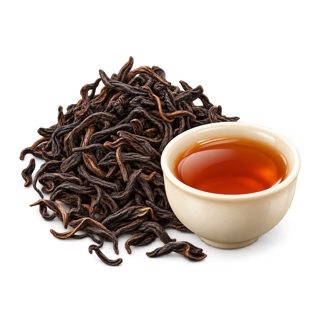
| Leaf form | Twisted strips |
| Added flavoring | Not independently verified; aroma names are not ingredient declarations |
| Cup leaf weight | 5 g |
| Cup water volume | 355 mL |
| Water temperature | 100°C / 212°F |
| Cup infusion time | 3–5 min |
| Gongfu leaf weight | 7 g |
| Gongfu water volume | 110 mL |
| Gongfu rinse | Approximately 5 seconds |
| Gongfu infusion sequence | 5, 5, 10, 15, 25, 40, 60, 80 seconds |
Rou Gui Oolong Tea
Zheyang Village, Wuyi Mountain, Nanping, Fujian, China · April 30, 2025
Tie Guan Yin Iron Goddess Oolong Tea
Anxi County, Quanzhou, Fujian, China · 2026-05-18; season label conflicts
Da Hong Pao Wuyi Rock Oolong Tea
Wuyi Mountain, Nanping, Fujian, China · 2025-04-30
Taiwan Jin Xuan Milk Oolong Tea — Unflavored
Ali Shan, Chiayi County, Taiwan · 2026-05-02