Choose a gong dao bei that can receive a complete infusion with comfortable headroom, then pour that infusion into your cups. Match it to your actual brewer output before choosing a material or decorative shape.
What the fairness pitcher changes
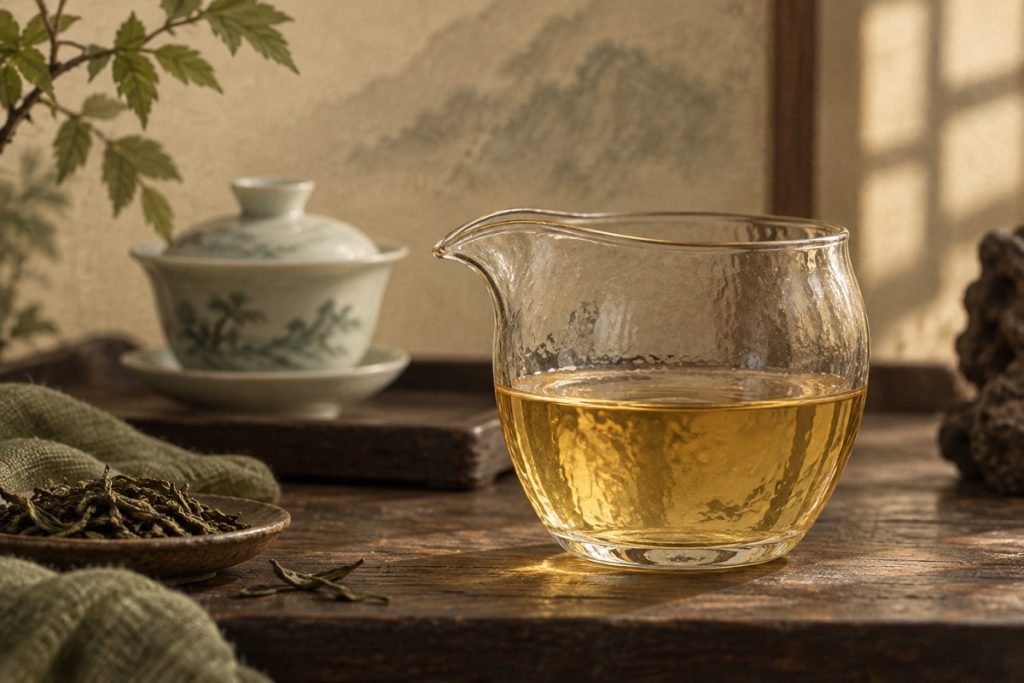
A gong dao bei receives the brewed liquor before it is divided among cups. This lets you empty the brewing vessel at one point in the session and distribute the collected infusion afterward. TeaVivre describes that role for its Yi Ran glass pitcher. It is especially useful when pouring directly into several cups would keep some liquid with the leaves while you serve the others.
A pitcher is not essential to every solitary cup. If your brewer can empty fully into one comfortable drinking vessel, another piece may add handling without solving a problem. For shared gongfu pours, it earns its place by separating extraction from serving.
Size it from the liquid you actually decant
- Measure your usual infusion’s output with cool water before a session. Use the brewer’s normal fill level; allow for the fact that leaves occupy space and retain liquid in real use.
- Choose a pitcher with room above that amount. A brim-full pitcher is an inconvenient serving target even when its stated capacity equals the brewer’s label.
- Check the capacity basis in the listing. “Water filled,” “under the filter” and an unspecified nominal volume are not automatically equivalent usable capacities.
- Check that your cups can receive the full infusion, or plan a second round from the pitcher. The cup-size guide explains this calculation.
Two listings show why the measurement wording matters
| Merchant example | Listed capacity | What it establishes |
|---|---|---|
| Yi Ran glass pitcher | 300 mL, water filled | A stated fill capacity, not a verified comfortable pouring volume |
| Glass pitcher with filter | 350 mL, under the filter | A capacity tied to the filter level, not an interchangeable brim measurement |
Both are described as borosilicate glass. These are specification examples, not a tested ranking or a recommendation based on owner durability data. Clear glass makes the liquid visible; that does not establish resistance to drops or permission for sudden temperature changes.
Check the pour and the landing space
Look for enough room to lift the pitcher without touching the brewer, cups or strainer. A comfortable handle or documented grip area matters more than a photograph that hides the hand position. Pour speed, dripping and heat at the grip need real-use evidence; a long spout alone does not prove good control.
If you use a separate tea strainer, check its support span against the pitcher opening. A built-in perforated filter and a fine mesh strainer do different jobs. Buy for the pouring routine you have, then add finer filtration only if particles in the cup bother you.