Steep & Origin

  • Home
  • Reviews
  • Best
    • All Best
      • Oolong Tea Picks
    • Chinese Black Tea Picks
    • Green Tea Picks
    • Matcha Picks
    • Pu-erh Tea Picks
    • Tea and Caffeine Picks
    • Tea pottery & teaware Picks
  • Guides
    • All Guides
      • Oolong Tea Guides
    • Chinese Black Tea Guides
    • Evening Tea Guides
    • Green Tea Guides
    • Matcha Guides
    • Organic Tea Guides
    • Pu-erh Tea Guides
    • Tea and Caffeine Guides
    • Tea and Health Guides
    • Tea pottery & teaware Guides
    • White Tea Guides
  • Comparisons
    • All Comparisons
      • Oolong Tea Comparisons
    • Chinese Black Tea Comparisons
    • Green Tea Comparisons
    • Matcha Comparisons
    • Pu-erh Tea Comparisons
    • Tea pottery & teaware Comparisons
  • Favorites
Guides

Do you need a strainer for gongfu tea?

3 min read
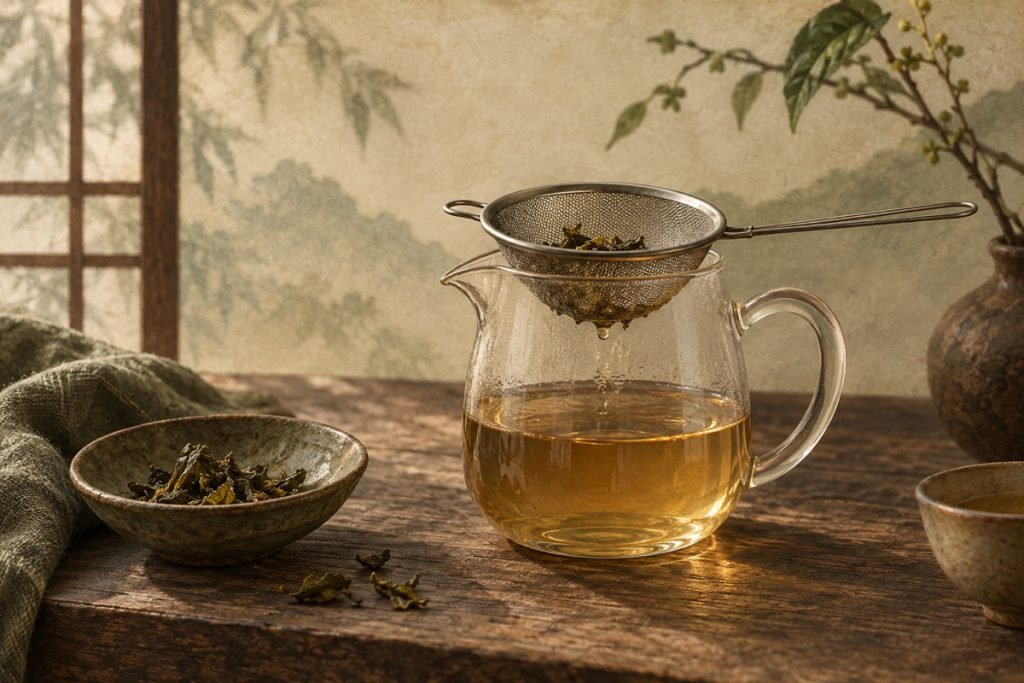
Illustrated Do you need a strainer for gongfu tea? — AI-generated editorial artwork

AI-generated editorial illustration; not an exact-product or customer photograph.

Table of Contents

Use a separate strainer when leaf fragments reaching your cup bother you and the strainer can sit securely over the receiving vessel. You do not need to add one solely because you brew gongfu tea.

Identify the particles before buying another tool

Large escaped leaves, small broken pieces and very fine leaf hairs are different filtration problems. Start by watching what comes out of your existing brewer with a comfortable, controlled pour. If the cup is already clear enough for you, a strainer adds another piece to rinse and dry without a necessary improvement.

A narrower gaiwan lid gap may retain more large leaf pieces, but it also changes the pour. Do not trade a secure grip for a tiny gap. Practice the basic gaiwan hold and pour with cool water before adjusting a hot session.

Built-in holes

A teapot’s outlet holes or a perforated lid help hold back larger leaves. The presence of holes does not establish a fine-particle cutoff.

Separate fine strainer

A finer screen can intercept smaller fragments after they leave the brewer. It needs stable support and enough flow for the infusion you pour.

Infuser inside the brewer

An infuser holds leaves while they extract. It is not the same component as a strainer placed between the brewer and pitcher.

Match the support before the mesh

  1. Measure the receiving vessel’s opening and check where the strainer’s rim or handles will rest. A product photograph is not a fit guarantee.
  2. Confirm the strainer’s documented material and care directions. Do not assume every white filter is metal mesh; TeaVivre’s porcelain strainer listing describes a cotton-thread filter.
  3. Set the empty assembly on a stable surface and check clearance. The outlet should discharge into the receiver, not onto its rim.
  4. In use, pour at a rate the strainer can pass. If it backs up, stop pouring and let it drain; do not push a hot, overflowing assembly into place.

Put filtration between brewing and serving

TeaVivre’s Silver Needle method shows the sequence: brewed tea passes through a strainer into a fairness pitcher, then into cups. That arrangement collects the infusion before sharing it. A properly sized pitcher still needs room for the liquid; the strainer does not increase its capacity.

A tea strainer is not a water purifier

Removing visible leaf pieces does not sterilize an infusion or remove dissolved caffeine. Choose filtration for cup texture and leaf control, not as a substitute for safe water or correct preparation.

After the session, empty the trapped material, clean according to the component’s instructions and allow it to dry before packing. If your routine involves travel, count that extra drying step. The useful purchase is a securely fitted tool that solves a particle problem you actually notice.

Frequently Asked Questions

Will a strainer remove tea bitterness?

It can remove suspended leaf material, but it cannot undo substances already extracted into the drink. Review dose and contact time if the infusion itself tastes too bitter.

Can I assume a travel pot’s lid filter replaces fine mesh?

No. Check the actual filter design. Perforated lids and fine screens need not retain the same particles.

Share this article

Twitter Facebook LinkedIn Email

Related Articles

Editorial illustration: Caffeine-free evening infusions: floral or fruity?

Caffeine-free evening infusions: floral or fruity?

Read More
Editorial illustration: Cooking with matcha: choose one preparation and measure it

Cooking with matcha: choose one preparation and measure it

Read More
Editorial illustration: Raw vs ripe pu-erh: choose the kind of session you want

Raw vs ripe pu-erh: choose the kind of session you want

Read More

About Steep & Origin

Chinese tea, thoughtfully explored.

We distinguish merchant tea details, customer experiences and editorial interpretation. We do not claim personal testing unless it has actually been performed.

Quick Links

  • Home
  • All Reviews
  • Best Articles
  • Comparisons
  • Guides
  • About
  • Contact
  • Privacy Policy

Categories

  • Chinese Black Tea
  • Evening Tea
  • Green Tea
  • Matcha
  • Oolong Tea
  • Pu-erh Tea

© 2026 Steep & Origin. All Rights Reserved.

We may earn a commission when you buy through our affiliate links. Affiliate disclosure