Size gongfu cups from the amount of tea you pour and the number of people you serve. The useful number is each cup’s comfortable drinking fill, not its brim capacity.
One infusion has to go somewhere
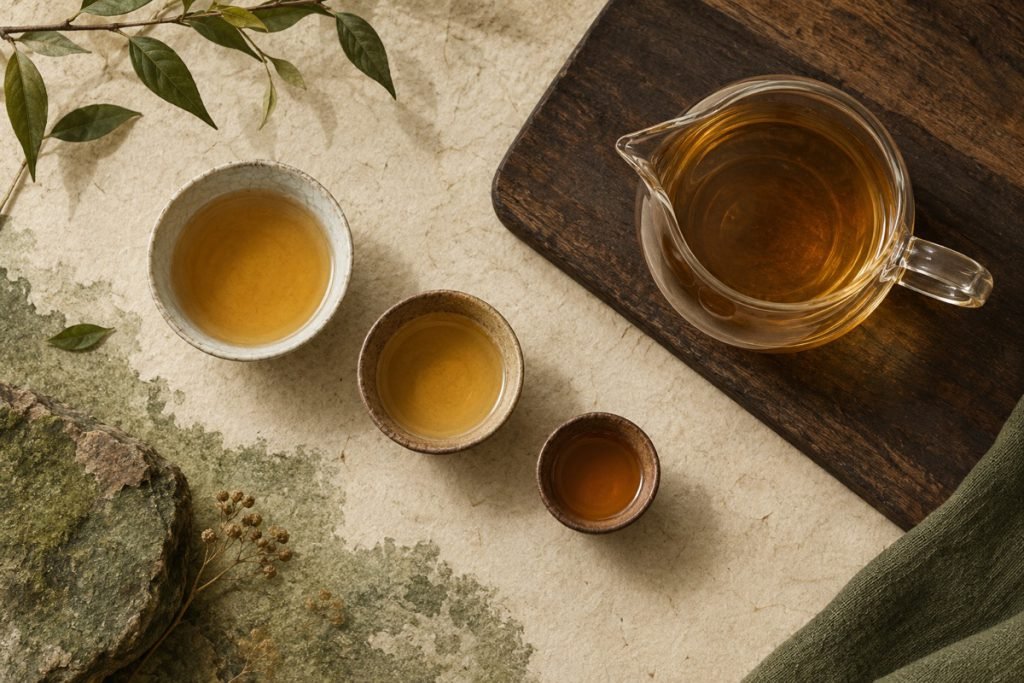
Measure the volume your brewer normally decants, then divide it by the number of drinkers. That gives a starting serving volume. It does not mean each cup should be filled to its top, or that every person must receive a single large serving. Smaller cups can take two rounds from a pitcher.
| Illustrative output | Drinkers | One equal serving each |
|---|---|---|
| 90 mL | 3 | 30 mL |
| 120 mL | 2 | 60 mL |
| 150 mL | 3 | 50 mL |
These are arithmetic examples, not measured outputs of particular teapots. If a cup is listed at 30 mL brim-full, it is not necessarily comfortable for the 30 mL serving in the first row. Leaf displacement, retained water and pouring losses also prevent a nominal brewer size from being a precise yield prediction.
Try your normal fill with cool water
- Place the cups on the surface you use for tea. Add a comfortable amount of cool water to each, leaving room to lift and sip.
- Measure that water and multiply by the number of cups. Compare the total with your brewer’s usual output.
- If the cups are too small for a single round, use a fairness pitcher and serve again. If you want one full round with no liquid waiting, choose larger cups or reduce the brewed amount deliberately.
Shape changes the drinking rhythm
A wide, shallow cup exposes more liquid surface than a narrower shape at a comparable fill, which can affect cooling. Actual temperature also depends on material, preheating, room conditions and how much tea is poured. In the Bluestone travel-set feedback, a small, wide cup is associated with quick cooling in an isolated customer report. That is a useful preference check, not a measured comparison of cup designs.
You like small repeated sips
Choose cups you can comfortably pick up and empty during the session. Accept that a pitcher may hold tea for the next round.
You want a longer individual drink
Check whether a larger cup or mug better matches the session. A three-cup bundle does not become a three-mug setup simply because the pot can be refilled.
Read set capacities as separate claims
The Ru Yao travel set lists a 150 mL pot and two 70 mL cups. The two cup figures total 140 mL, but that arithmetic does not verify a full, comfortable distribution of the pot’s working output. The fill basis is unspecified. Ask for usable fill information if serving size is decisive.
Choose the number of drinkers and serving rhythm first. Then confirm that each cup is comfortable to handle and the combined capacity fits that plan. Color and glaze can settle the choice once the serving problem is solved.