“Milk oolong” is a name to investigate, not an ingredient list. For the two Jin Xuan products examined here, the decisive distinction is explicit: one is sold without added flavoring, while the other has added edible flavoring. Creamy tasting language alone cannot tell you which product you are buying.
Jin Xuan identifies the leaf; added flavoring identifies a different choice
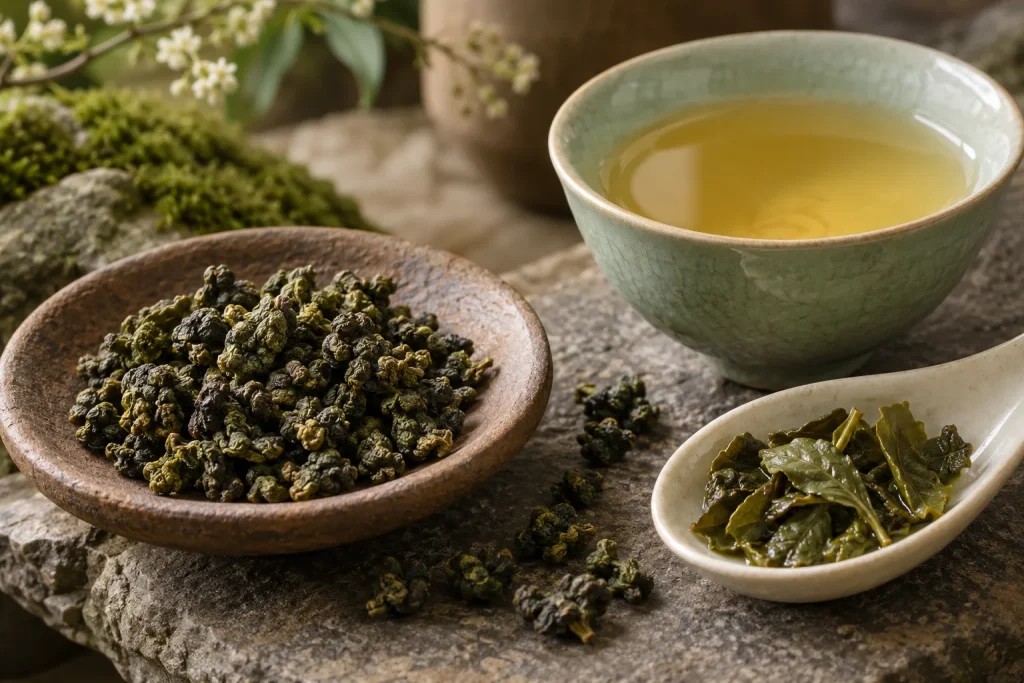
Both assessed products are listed as Taicha 12/Jin Xuan from Ali Shan, Taiwan. The merchant distinguishes the unflavored tea from a flavored version. That shared cultivar does not make their aromatic profiles identical, and “flavored” is not a higher grade of the unflavored tea.
What creaminess can mean in an unsweetened cup
Customer descriptions of the unflavored Jin Xuan include soft texture, flowers, green notes and variable milk-like impressions. Some emphasize mouthfeel more than aroma. Feedback on the flavored Jin Xuan includes fruit-cream or candy-like aroma, with both overpowering and too-faint experiences. These are perceptions, not measured ingredient amounts.
Read the ingredient statement before making a dietary assumption
A milky descriptor does not prove dairy was added, and a customer saying a tea is dairy-free does not certify the formulation. If an ingredient or allergen matters, request an exact-product statement for the selected pack. The flavored listing’s general wording does not answer every composition question.
Preparation cannot settle a product-identity question
Changing time can alter a cup, but it cannot prove that flavoring is absent. Both listings publish the same 5 g/355 mL cup method at 100°C for 3–5 minutes and the same 7 g/110 mL gongfu routine. A recipe match does not erase the ingredient distinction. Use the exact flavored-versus-unflavored comparison for the purchase decision.
Choose no added flavoring
Look for an explicit statement, then decide whether a subtle floral-green tea with a possibly creamy texture is the experience you want.
Choose a scented tea deliberately
An added sweet aroma may be enjoyable when it is the goal. Buy a small pack to check intensity rather than assuming “milk” means a predictable dessert flavor.
Turn the name into a useful buying question
The question to ask before ordering
Is this the unflavored Jin Xuan or the explicitly flavored product, and does the exact ingredient information meet my needs? Resolve that first.
The question to ask after brewing
Do I enjoy the tea itself, including the finish, or only the scent? Keep those answers separate when deciding whether to buy it again.
Exact merchant sources: Taiwan Jin Xuan Milk Oolong Tea — Unflavored, Taiwan Jin Xuan Milk Oolong Tea — Flavored. Recipes are documented starting points; adjustment advice is not a report of controlled testing.