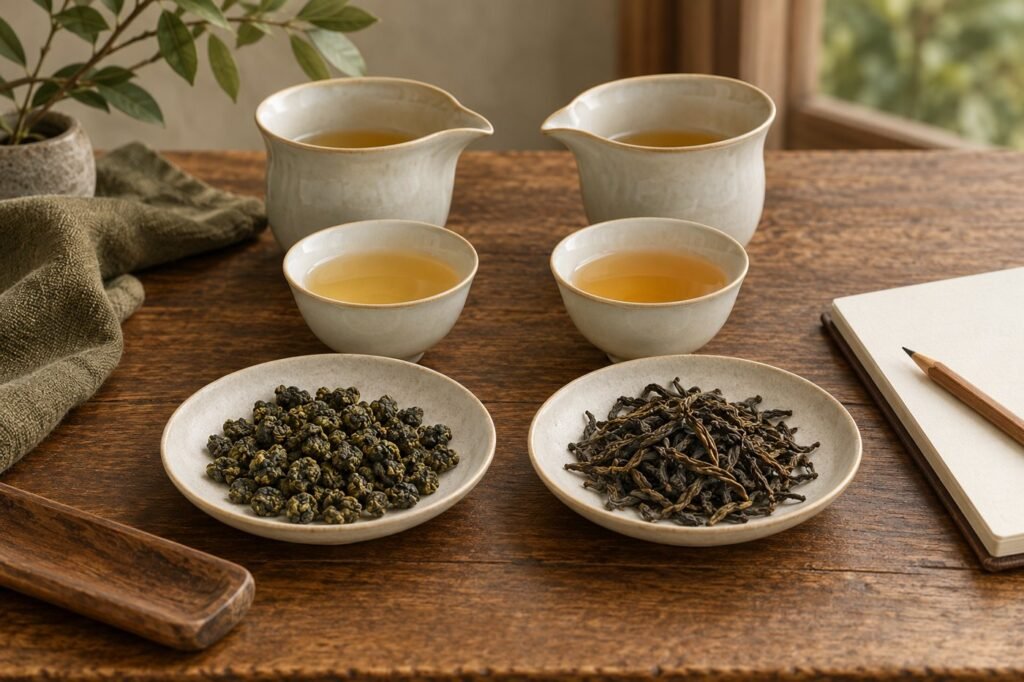
Decide whether you are comparing each tea at its recommended preparation or deliberately testing both under identical settings. Those are different questions. Keep your notes simple enough to repeat the comparison rather than turning one impressive cup into a permanent ranking.
Choose the question first
Which would I make again?
Begin with each exact tea’s documented recipe. You are comparing two realistic drinking routines, even if their doses or times differ.
What changes under the same settings?
Use the same measured dose, water, temperature and timing deliberately. A result then describes that one experiment; it does not prove that either tea was prepared at its best.
The Ali Shan and Li Shan pair happens to share the same cup recipe, making it a useful first exercise. Rou Gui and Organic Shui Xian do not: their cup weights and times differ substantially. Treating both pairs identically would hide a meaningful difference.
A repeatable small comparison
- Label the two samples clearly and confirm that each contains enough leaf for the chosen preparation and a repeat trial.
- Use comparable clean vessels and the same water source. If the vessels differ, record that limitation.
- Weigh the leaf and measure the water. Do not compare equal spoonfuls of tightly rolled and loose strip-shaped leaves.
- Prepare the cups in the same sequence each time and decant fully. Avoid letting one continue steeping while you write notes about the other.
- Compare aroma, body, finish and the main drawback separately. Taste once the cups are comfortably drinkable, and avoid forcing yourself to identify every advertised note.
- Repeat the more uncertain result on another occasion before buying a large quantity. Change only the factor you mean to investigate.
Write a decision, not a score you cannot explain
| Less useful note | More useful question |
|---|---|
| Tea A is objectively better | Which cup would I choose for my usual morning or evening routine, and why? |
| I cannot taste the advertised fruit | Is the cup still enjoyable, and what can I actually describe? |
| Tea B lasted more steeps | Were the dose and cup volumes comparable, and were those later cups pleasant? |
| The expensive tea must win | Would its specific texture or finish change my next purchase? |
This is an editorial home-comparison routine, not a standardized sensory test. Mood, food, water, timing and harvest can still influence the result. Use the existing water troubleshooting guide if both cups seem unexpectedly flat, and the sample-order guide to plan the next purchase around what you learned.