Li Shan oolong review: a delicate cup with a savory side
Li Shan is a candidate for someone who enjoys delicate fragrance, buttery texture and a green or savory finish. It is not reliably more floral or powerful than other Taiwanese oolongs. The original feedback makes room for both orchid-like sweetness and a noticeably mineral, umami-led cup.
We may earn a commission if you buy through our links. Affiliate disclosure.
At a Glance
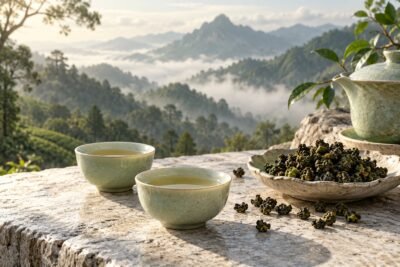
KEY FEATURES
- Li Shan high-mountain oolong
- Qingxin / Chin Shin
- Cup: 5 g / 355 mL / 100°C (212°F) / 3–5 min
Tea assessment
Research-based editorial fit scores, not personal testing or measured intensity. Historical customer experiences may differ from the current batch.
Green, savory and floral accounts support a delicate rather than forceful role.
Buttery texture and persistent finish are supported strengths.
Clear recipes still yield variable bitterness and intensity.
Some long sessions are positive, but early fading also appears.
PROS
- Savory and mineral impressions offer a distinct route.
- Soft texture and a lingering finish support slow drinking.
CONS
- Delicacy can feel insufficiently expressive.
- Bitterness and endurance are not uniform.
Li Shan’s savory side is a reason to choose it
This Qingxin listing is worth considering for more than a generic promise of mountain fragrance. Detailed customer feedback describes green, umami and mineral-like impressions with a buttery body. Here “mineral” is a tasting association, not a statement about nutritional content. A drinker who likes that savory direction may find it more interesting than a simply sweeter or louder floral cup.
Other accounts emphasize orchids, sweetness and a clean finish instead. The disagreement does not need to be resolved into one definitive flavor profile. It tells you that Li Shan is a poor blind purchase if your requirement is an intensely floral tea with no green character.
A shared recipe makes Ali Shan a useful comparison
The reviewed Li Shan and Ali Shan have the same listed conventional cup dose and eight-pour gongfu schedule. That makes a comparison practical, but the leaves are not interchangeable: this Li Shan uses Qingxin, while Ali Shan names Jin Xuan, and the listings concern different batches. Compare their cultivar, cup character and tradeoffs before interpreting either name as an automatic upgrade.
Cup
5 g / 355 mL / 100°C (212°F) / 3–5 min. Decant at the chosen time. The cup instructions do not specify a rinse.
Gongfu
7 g / 110 mL / 100°C (212°F). Approximately 5 seconds. Infusion sequence: 25, 25, 30, 40, 60, 90, 120, 180 seconds. Drain fully between pours.
The figures above are from TeaVivre’s Li Shan listing. As an editorial comparison method, prepare each tea with measured quantities and note the finish after swallowing. If the green-savory side is what attracts you, record whether it remains pleasant rather than judging solely by how strong the flowers are.
Delicacy needs to be something you enjoy
Smoothness and buttery texture are positive themes, but some feedback still finds the cup too light. Increasing extraction cannot be assumed to supply the missing aromatic character; grassiness and some bitterness also appear in the source accounts. Li Shan makes more sense when a restrained but textured cup is the objective, not when you are trying to replace a bold roasted tea.
Pros & Cons Analysis
Based on supplied customer reviews and verified product documentation
Pros
- The greener, umami side can appeal to someone who wants more than perfume from a light oolong. It is a reported sensory association, not a measurement of the tea’s mineral content.
- Positive accounts pair buttery or velvety mouthfeel with fragrance after swallowing. That gives a delicate cup substance without requiring a heavy roast.
Cons
- Some drinkers find it too light, less floral, or less potent than another high-mountain tea. A higher-priced or Nonpareil label does not settle that preference.
- Grassiness and bitterness appear alongside otherwise favorable impressions; another account finds three strong steeps and a weaker fourth. Avoid treating the eight-pour schedule as guaranteed yield.
Our verdict
Choose Li Shan when a delicate, buttery cup with a green-savory finish sounds appealing. Sample it beside Ali Shan before paying for a larger pack. If your main aim is a strong floral burst, neither the mountain name nor the grade makes that a certainty.
Frequently Asked Questions
Does this prove Li Shan is better than Ali Shan?
No. These are different exact products with different cultivars and listed harvests, assessed from separate customer evidence.
Is the mineral note a nutritional claim?
No. It is a sensory description in customer feedback, not measured mineral content.
Tea details
| Tea style | Li Shan high-mountain oolong |
|---|---|
| Seller-stated origin | Fushoushan Farm, Lishan Mountain, Taichung, Taiwan |
| Cultivar | Qingxin / Chin Shin |
| Listed harvest | October 26, 2025 |
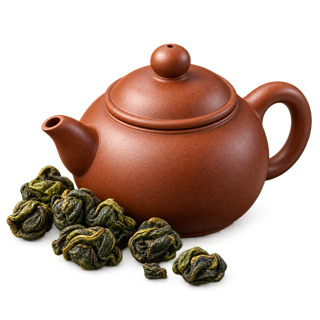
| Leaf form | Rolled balls |
| Added flavoring | Not independently verified; aroma names are not ingredient declarations |
| Cup leaf weight | 5 g |
| Cup water volume | 355 mL |
| Water temperature | 100°C / 212°F |
| Cup infusion time | 3–5 min |
| Gongfu leaf weight | 7 g |
| Gongfu water volume | 110 mL |
| Gongfu rinse | Approximately 5 seconds |
| Gongfu infusion sequence | 25, 25, 30, 40, 60, 90, 120, 180 seconds |
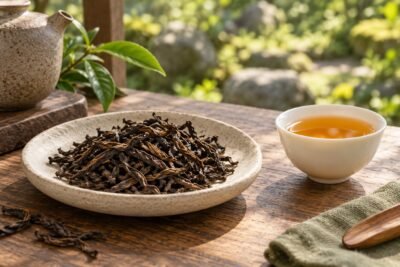
Organic Shui Xian (Water Sprite) Oolong Tea
Panlan Village, Yong’an, Fujian, China · September 12, 2025
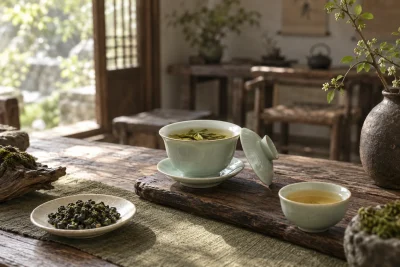
Taiwan Jin Xuan Milk Oolong Tea — Unflavored
Ali Shan, Chiayi County, Taiwan · 2026-05-02
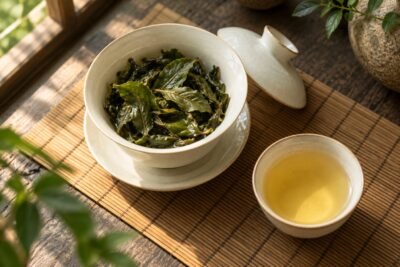
Taiwan Dong Ding (Tung Ting) Oolong Tea
Dongding, Lugu Township, Nantou, Taiwan · May 18, 2026
Taiwan Wen Shan Baozhong (Pouchong) Oolong Tea
Zhushan, Nantou, Taiwan; garden listed as Shan Lin Xi Tea Area · May 3, 2026