Lu Shan Yun Wu review: a nutty, vegetal everyday option
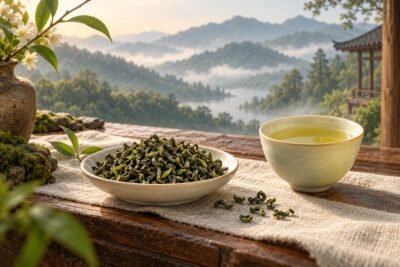
Lu Shan Yun Wu is worth sampling if you want a Chinese green tea with both vegetal freshness and a nutty side. Its small curled leaves offer a different preparation experience from long, flat Hou Kui. The important buying distinction is the exact listing: this is the standard Lu Shan Yun Wu, not the separate Premium version.
We may earn a commission if you buy through our links. Affiliate disclosure.
At a Glance
KEY FEATURES
- Lu Shan Yun Wu
- Lushan, Jiujiang, Jiangxi, China
- Cup: 2 g / 250 mL / 85°C / 185°F / 3–5 min
Tea assessment
Research-based editorial fit scores, not personal testing or measured intensity. Historical customer experiences may differ from the current batch.
Nutty, sweet and vegetal accounts support an everyday green-tea role.
Creamy and buttery impressions are a strength; mild bitterness remains possible.
A measured cup recipe is available, but sour or bitter results make adjustment worthwhile.
Later nutty and sweet infusions are reported without a dependable yield guarantee.
PROS
- Nutty and vegetal notes offer a layered green-tea direction.
- Customer feedback supports repeated everyday use.
- Later infusions can retain interest as the profile changes.
CONS
- Vegetal character remains prominent for some drinkers.
- Mild bitterness occurs; the Premium version is a different choice.
Which Yun Wu is being reviewed?
The linked TeaVivre listing identifies Lushan in Jiangxi and Wu Lao Feng Tea Garden. It also offers navigation to another grade. Do not let a “Premium” product tag substitute for the full listing name: the standard and Premium pages are separate choices. The displayed harvest is April 10, 2026; the customer accounts extend across earlier harvests.
Nutty does not mean the greens disappear
Customer descriptions combine chestnut-like or lightly toasted impressions with cooked greens, fresh grass and a sweet finish. Some describe a creamy texture; others experience a light, simple cup. The useful expectation is a green tea with a nutty dimension, not a roasted beverage that conceals its vegetal character.
A sensible reason to try it
You already enjoy green tea and want another everyday direction. Original feedback includes repeat purchases and satisfaction with the interplay of green and nutty notes.
A reason to stay with a sample
You are trying to escape vegetal flavor altogether, or you expect the standard grade to reproduce the Premium version. The evidence supports neither assumption.
A few reports favor one grade over the other in opposite directions. That disagreement is useful: a higher grade label is not a substitute for finding the taste you enjoy. No controlled comparison of the current two grades is available here.
Brewing starting points
The exact TeaVivre listing supplies these two preparations. Keep the dose, water and time together when choosing a method.
Cup method
2 g · 250 mL · 85°C / 185°F · 3–5 min. Separate the tea from the leaves after the timed steep. No cup-method rinse is specified.
Gongfu method
4 g · 110 mL · 85°C / 185°F. Infusions: 15, 20, 30, 40 s; rinse not specified. Decant each infusion fully.
Use the two recipes for different sessions
The cup method uses half the leaf of the gongfu method but more than twice the water. Keep those recipes separate. Transplanting the four-gram dose into a long steep changes the preparation substantially.
Start at the shorter end of the cup range if mild bitterness is a concern, then taste before extending it. Accounts of a smooth finish coexist with mild bitterness and a more sour or citric first infusion. Those descriptions are not proof that the tea is defective, nor a guarantee that every drinker will find them pleasant.
If a promising tea tastes flat, check your brewing water before changing several settings at once. For an alternative leaf format, the Hou Kui review explains the practical consequences of brewing very long leaves.
Pros & Cons Analysis
Based on supplied customer reviews and verified product documentation
Pros
- A bridge between green and toasted impressions. Accounts describe chestnut, bean and lightly roasted notes alongside fresh greens. It makes sense for a drinker who enjoys both sides rather than wanting one to erase the other.
- Ordinary use is a credible role. Repeat buyers and sample-to-reorder experiences support an everyday cup. They do not establish that this is universally preferable to other green teas.
- Try the later cups before deciding. Some sessions move from greener impressions toward nuttiness and sweetness. The intensity can decline, so repeat infusion is an opportunity rather than a fixed yield.
Cons
- Not an escape from green flavor. Grass, spinach and cooked-green associations recur in the read set. A reader who dislikes that family may be better served by a different tea category.
- Neither smoothness nor grade preference is unanimous. Mild bitterness and differing standard-versus-premium preferences remain in the evidence. A sample is more informative than assuming the label settles the choice.
Our verdict
Try standard Lu Shan Yun Wu for a measured everyday green cup with nutty and vegetal interest. If you already enjoy that flavor family, it adds a useful alternative to the cupboard. If vegetal notes are the problem, changing the grade may not solve it.
Frequently Asked Questions
Is standard Lu Shan Yun Wu the same as Premium Lu Shan Yun Wu?
No. The merchant has separate listings. This review and its brewing instructions refer to the standard listing linked here.
Should I rinse it before gongfu brewing?
The inspected recipe gives four infusion times but does not specify a rinse. Do not import a rinse duration from another green tea.
Tea details
| Tea style | Lu Shan Yun Wu |
|---|---|
| Seller-stated origin | Lushan, Jiujiang, Jiangxi, China |
| Cultivar | Small-leaf tea bush species |
| Harvest date | 2026-04-10 |
| Cup method: leaf | 2 g |
| Cup method: water | 250 mL |
| Cup method: temperature | 85°C / 185°F |
| Cup method: time | 3–5 min |
| Gongfu method: leaf | 4 g |
| Gongfu method: water | 110 mL |
| Gongfu method: temperature | 85°C / 185°F |
| Gongfu infusion sequence | 15, 20, 30, 40 s; rinse not specified |
| Seller storage instructions | Airtight, opaque packaging; refrigerated |
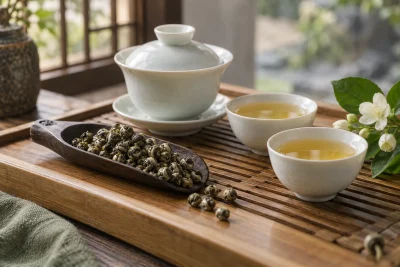
Premium Jasmine Dragon Pearls Green Tea
Fuding City, Fujian Province · 2026-04-30
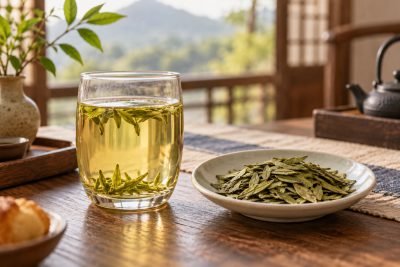
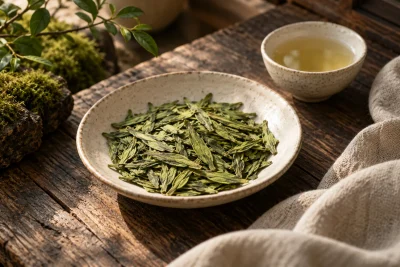
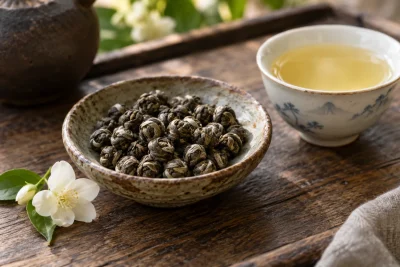
Jasmine Dragon Pearls Green Tea
Jasmine - Hengxian County, Nanning City, Guangxi Province Green Tea - Jinggu County, Puer City, Yunnan Province · 2026-04-13