Dragon Well review: a tea for everyday cups
Nutty, vegetal and gently floral. A closer look at an everyday green tea and the brewing choices that shape it.
We may earn a commission if you buy through our links. Affiliate disclosure.
At a Glance
KEY FEATURES
- Style: Dragon Well / Long Jing green tea
- Seller-stated origin: Meijiawu Village, Xihu District, Hangzhou, Zhejiang, China
- Current listed harvest: 2026-04-06
- Cup recipe: 2 g / 250 mL / 185°F (85°C)
Tea assessment
Research-based editorial assessment for the uses described below, not personal tasting or hands-on testing. Scores are qualitative judgments out of 5, separate from customer stars; historical feedback may cover other harvests or variants.
Nutty-green character and a floral accent appeal in the selected feedback; missing nuttiness is also reported.
Enjoyable daily cups coexist with bitterness and requests for greater refinement.
Some feedback describes improvement with less leaf; cup and gongfu recipes must stay separate.
Enjoyable repeat infusions are reported, without a guaranteed six-cup yield.
PROS
- Nutty, green flavor appeals to everyday drinkers in the cited accounts.
- Some drinkers enjoy a second or third infusion.
- A 2026 sample account describes an appealing floral aroma.
CONS
- Bitterness can require dose or timing adjustments.
- Some customers prefer Premium or want more complexity.
- One historical report describes broken leaves and reduced smoothness.
The seller’s standard Dragon Well is worth considering if you want a nutty, green-tasting tea for an ordinary cup and are willing to adjust the brew. It is less convincing as a blind bulk purchase for someone chasing maximum delicacy: customers have described both satisfying everyday cups and bitterness or limited complexity.
Know which Dragon Well you are buying
The product here is Dragon Well Green Tea (Long Jing), the standard listing, not the seller’s Premium, Organic Superfine or Nonpareil versions. On October 3, 2026, the seller’s current listing named Meijiawu Village in Xihu District, the Longjing #43 cultivar and an April 6, 2026 harvest. These are seller-stated tea details, not our independent authentication of origin.
Those details matter more than an informal entry-level label. The currently listed Premium Dragon Well has a different stated origin and harvest date. Older customer references to a particular region or grade should not override the present listing.
The flavor question: comforting or too straightforward?
Nutty notes and a floral edge
Sweetness, nutty flavor and a light floral aroma are part of the appeal described in the customer feedback. The same evidence also points to sensitivity to oversteeping and a simpler cup than some drinkers want. Consider it for an enjoyable everyday brew rather than assuming it will be the most refined Dragon Well in your cupboard.
A different palate, a different result
The flavor is not equally convincing to every palate. Feedback also describes missing nuttiness and a lighter cup than expected. These contrasting impressions span different harvests and brewing conditions; they help define the choice without predicting your pack.
Brewing standard Dragon Well at 85°C
Cup & infuser
For one measured cup at a time
- Leaf
- 2 g
- Water
- 250 mL
- Temperature
- 85°C / 185°F
- Steep
- 3–5 minutes
Start at 3 minutes. Remove the infuser or pour the tea away from the leaves, then taste when comfortable to drink.
Gongfu & gaiwan
For a sequence of short infusions
- Leaf
- 4 g
- Water
- 110 mL
- Temperature
- 85°C / 185°F
- First infusion
- 15 seconds
Rinse: the listing indicates a rinse but gives no duration.
Drinking infusions: 15 → 15 → 20 → 25 → 35 → 50 seconds. Pour off each infusion before the next.
Recipes: this tea’s merchant brewing instructions, checked October 3, 2026. Starting at three minutes is our suggested first trial within the published range; these are not in-house tasting results.
Adjust strength before changing the grade
| What you notice | What to try or consider |
|---|---|
| The first cup is too strong | Confirm the method and measured dose first. Customer feedback includes improved results with less leaf. A modest dose reduction is an option to explore, not a replacement official recipe. |
| The cup is lighter than you want | For cup brewing, move within the documented 3–5 minute range before changing dose and time together. More strength is not the same as more complexity. |
| You like it, but want more refinement | Try a small Premium sample before a larger order. The two listings have different stated origins and harvests, so this is a preference trial rather than a controlled grade comparison. |
Before choosing a pack
Buy an amount you can evaluate before committing to a large order. The evidence includes an isolated historical complaint about broken leaf and reduced smoothness; it does not establish the condition of current packs. Check the selected harvest, weight and dispatch location. No comparable live pack price has been verified, so this review makes no current price-per-gram claim.
If the choice is specifically between the two named listings, our standard versus Premium comparison separates documented differences from customer preferences. The green-tea hub links both reviews and the brewing instructions without assuming that a grade label settles the choice.
Pros & Cons Analysis
Based on supplied customer reviews and verified product documentation
Pros
- An everyday cup with recognizable character. Customer feedback connects grassy and nutty flavors with an enjoyable routine brew, with sweetness adding interest. This makes the tea a plausible starting point if you already like green and roasted-nut notes. Historical value opinions do not establish a current price advantage.
- Reinfusion is worth exploring. Enjoyable second and third steeps appear in the feedback. Try another infusion while the cup remains appealing, rather than discarding the leaves automatically. The merchant’s six-step schedule does not promise six equally satisfying cups.
- A floral accent can add interest. The evidence includes appreciation of an orchid-like aroma as well as the more familiar nutty character. That gives floral-note drinkers a reason to consider a sample. Its presence and intensity are not established for every pack.
Cons
- The brewing window matters. The evidence includes bitterness that improved with a lower leaf dose, alongside experiences without that problem. Keep method, timing and quantity consistent while making adjustments. The contrast does not support treating bitterness as inevitable or impossible.
- It may not satisfy a search for refinement. The feedback includes a preference for Premium and a wish for more complexity. Those are reasons to compare small quantities, not proof that standard is objectively inferior. The current origins differ, so the pair is not a controlled same-leaf grade comparison.
- Inspect the leaf on arrival. An isolated historical complaint about broken leaf adds a physical reservation beyond taste. Check your own pack before attributing a rough cup entirely to technique. The evidence does not establish how frequently this occurs.
A daily Dragon Well, with room to adjust
Where Dragon Well fits
Choose the standard Dragon Well as a small-quantity trial if nutty green flavor and an everyday brewing routine matter more to you than fine distinctions between grades. The cited customers give reasons to try another infusion and look for a floral accent, but also reasons to keep the first purchase modest.
The preference that rules it out
If you already know you dislike bitterness or you are buying specifically for extra complexity, compare a sample with Premium before scaling up. The standard tea’s current Xihu origin is a useful identity detail; it is not a substitute for finding out whether you like the cup.
Frequently Asked Questions
Is this the same tea as Premium Dragon Well?
No. These are separate the merchant listings. As checked on October 3, 2026, the standard tea names Meijiawu in Xihu District; Premium names Qiantang District. Packaging and harvest must still be checked when ordering.
How should I brew this Dragon Well?
the seller’s cup method uses 2 g in 250 mL at 185°F (85°C) for 3–5 minutes. The gongfu method uses a different ratio and much shorter times; see the brewing guide.
Are the photos and score from your own testing?
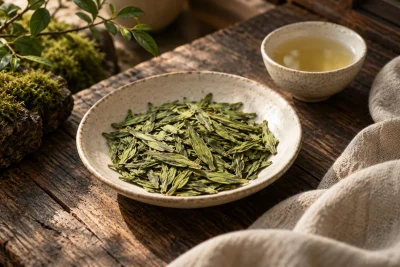
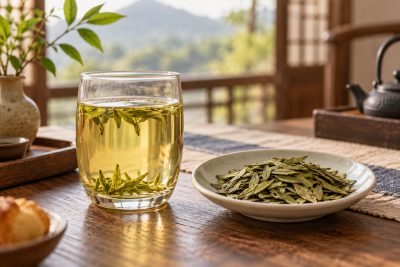
No in-house tasting or customer-photo reuse is claimed. The artwork is an editorial illustration, and the assessment bars are research-based judgments, not results of personal tasting.
Tea details
| Tea style | Dragon Well (Long Jing), green tea |
|---|---|
| Seller-stated origin | Meijiawu Village, Xihu District, Hangzhou, Zhejiang, China |
| Cultivar | Longjing #43 |
| Harvest date | 2026-04-06 |
| Cup method: leaf | 2 g |
| Cup method: water | 250 mL |
| Cup method: temperature | 85 °C / 185 °F |
| Cup method: time | 3–5 min (180–300 s) |
| Gongfu method: leaf | 4 g |
| Gongfu method: water | 110 mL |
| Gongfu method: temperature | 85 °C / 185 °F |
| Gongfu infusion sequence | 15, 15, 20, 25, 35, 50 s, after rinse |
| Seller storage instructions | Airtight, opaque packaging; refrigerated (seller instructions) |
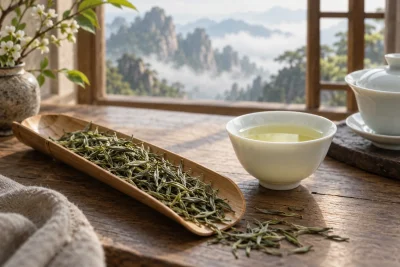
Huang Shan Mao Feng Green Tea
Da Guyun village, Shexian(歙县), Huangshan, Anhui Province · 2026-04-16
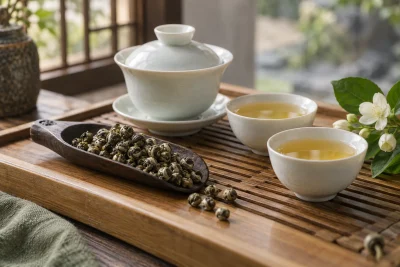
Premium Jasmine Dragon Pearls Green Tea
Fuding City, Fujian Province · 2026-04-30