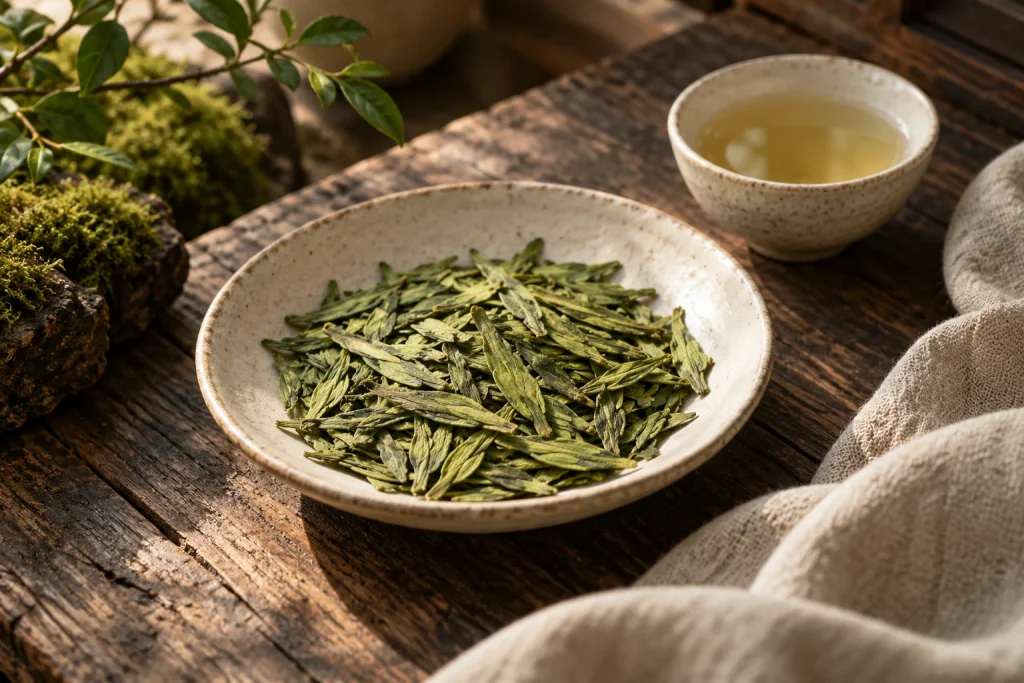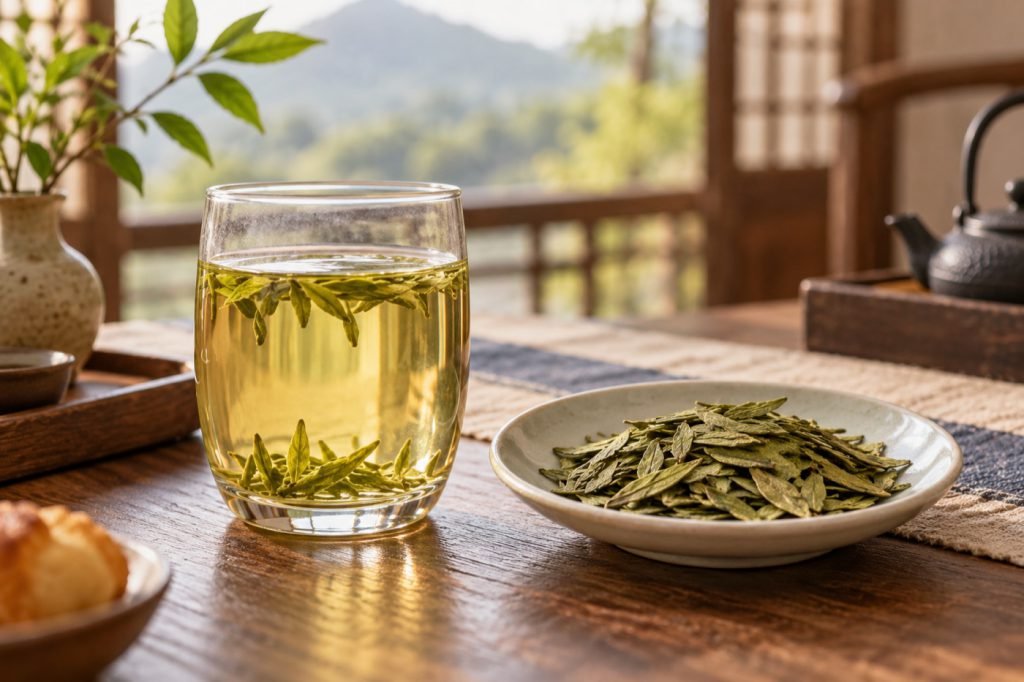
The useful question is whether Premium fits your taste and brewing routine better—not whether its name sounds like an upgrade. The merchant currently lists these as Dragon Wells from different places, with different harvest dates. The customer evidence contains both Premium preferences and satisfying standard-tea sessions.
Start with standard
Consider a small amount if nutty green-tea flavors already appeal to you. Allow room to adjust strength.
Explore Premium
Try it if following the leaf through short steeps is part of the pleasure. Later cups can still fade.
Reconsider the style
If vegetal notes are the problem, changing the grade may not solve your preference.
The current listings are not a controlled grade comparison
On October 3, 2026, the standard listing named Meijiawu, Xihu District and an April 6 harvest; Premium named Qiantang District and April 15. Both list Longjing #43. Those are merchant claims, and they are more useful for identifying the teas than old customer references to XiHu Premium. Earlier harvest is not proof of a better cup.
The cup recipes also differ: standard uses 2 g per 250 mL, while Premium uses 1.5 g. Both specify 185°F (85°C) and 3–5 minutes. For gongfu, both use 4 g per 110 mL but publish different timing sequences. Compare them using the appropriate method before attributing every difference to the leaf.
What the customer comparisons actually establish
Preference does not establish a winner
The customer evidence includes a preference for Premium’s subtler character alongside enjoyment of standard Dragon Well as a satisfying cup in its own right. That supports comparing small quantities when refinement matters to you. It does not establish a winner for the current pair of harvests.
Infusion counts need context
Both teas have feedback describing enjoyable repeat infusions, while Premium also has reports of results varying between sessions. Infusion counts are not directly comparable without matching leaf, water, timing and the drinker’s taste threshold. Treat the recipes as preparation guidance rather than a yield ranking.
If you already own either tea, the two-recipe brewing guide is a more useful next step than replacing it solely because a first cup was too strong. The cards below connect each tea to a specific buying situation; the shared tea-details table follows them.