Premium Dragon Well review: a slower tasting session
Chestnut, green bean and a floral edge. Explore the harvest, brewing recipe and contrasting customer experiences.
We may earn a commission if you buy through our links. Affiliate disclosure.
At a Glance
KEY FEATURES
- Style: Dragon Well / Long Jing green tea
- Seller-stated origin: Qiantang District, Hangzhou, Zhejiang, China
- Current listed harvest: 2026-04-15
- Cup recipe: 1.5 g / 250 mL / 185°F (85°C)
Tea assessment
Research-based editorial assessment for the uses described below, not personal tasting or hands-on testing. Scores are qualitative judgments out of 5, separate from customer stars; historical feedback may cover other harvests or variants.
Chestnut, bean and floral impressions suit a savory green-tea preference.
Sweetness and smoothness coexist with bitterness and an isolated metallic-taste objection.
Documented cup and gongfu methods differ in concentration; adjustments do not resolve every taste objection.
Changing short infusions are part of the appeal, but fading sessions also appear.
PROS
- Chestnut, bean and floral character suits drinkers seeking that flavor profile.
- Specific customer sessions support exploring several short infusions.
- Recent repeat-buyer accounts describe an enjoyable daily tea.
CONS
- Some accounts describe bitterness or an unpleasant cup despite adjustments.
- Enjoyable infusion count varies between sessions.
- Vegetal or restrained flavors will not suit every palate.
- One older-harvest account reports flavor loss during storage.
The seller’s Premium Dragon Well makes the strongest case for a reader who enjoys chestnut and bean-like green-tea flavors and wants to explore successive short infusions. It still calls for a measured trial: the customer record includes cups described as bitter, uninteresting or unpleasant, and the word “Premium” does not resolve those preferences.
Premium is the listing name; check the current identity
The exact listing is Award Winning Premium Dragon Well Long Jing Green Tea. On October 3, 2026, the seller’s current listing specified Qiantang District in Hangzhou, Longjing #43 and an April 15, 2026 harvest. The current page should take precedence over old reviews calling the tea XiHu. We have not independently authenticated its origin or established an award for the current harvest.
This differs from the standard Dragon Well, whose current page names Meijiawu in Xihu District and an earlier April harvest date. Neither the name nor the date proves which one you will prefer.
Why a repeat-infusion drinker might try it
Following the flavor through a session
Customer feedback describes a savory combination of green bean and chestnut, with floral notes and sweetness. Short-infusion sessions can reveal changes in strength and finish, including a little bitterness followed by sweetness. Later cups may retain flavor even as they become lighter.
Later cups can fade
The attraction is following the tea through a session, rather than reaching a fixed number of cups. Feedback also describes flatter sessions and fewer satisfying infusions. Storage and measurement may contribute, but the evidence does not establish a single cause or guarantee repeatable results.
Read the negative experiences as taste boundaries
The negative feedback includes dislike of cooked-vegetable character and a preference for other tea styles. This is a useful taste boundary: if savory green-tea flavors do not appeal to you, a Premium label may not change the experience.
Quality reservations also appear in the evidence, including bitterness, reduced smoothness and an isolated metallic-taste complaint despite brewing adjustments. These experiences span older stock and cannot diagnose current packs, but they make a promise of universal smoothness inappropriate.
Premium Dragon Well: cup dose and short infusions
Cup & infuser
For one measured cup at a time
- Leaf
- 1.5 g
- Water
- 250 mL
- Temperature
- 85°C / 185°F
- Steep
- 3–5 minutes
Start at 3 minutes. Remove the infuser or pour the tea away from the leaves, then taste when comfortable to drink.
Gongfu & gaiwan
For a sequence of short infusions
- Leaf
- 4 g
- Water
- 110 mL
- Temperature
- 85°C / 185°F
- First infusion
- 15 seconds
Rinse: around 5 seconds.
Drinking infusions: 15 → 25 → 40 → 60 → 90 seconds. Pour off each infusion before the next.
Recipes: this tea’s merchant brewing instructions, checked October 3, 2026. Starting at three minutes is our suggested first trial within the published range; these are not in-house tasting results.
Decide when the Premium session has given enough
| What you notice | What to try or consider |
|---|---|
| You enjoy the first few infusions | Follow the sequence while the cup remains enjoyable. The feedback includes both flavorful later infusions and sessions that fade sooner. Stop according to your palate rather than treating the schedule as a target. |
| Vegetal character is the problem | The feedback includes dislike of this flavor family. Before buying more, consider whether Dragon Well suits your palate; a Premium label cannot settle that. |
| You brew only occasionally | Begin with a smaller quantity and follow the pack’s storage instructions. Do not use an old customer account as a fixed shelf-life prediction. |
A smaller first purchase makes sense if you drink green tea infrequently. Historical feedback includes flavor loss during storage, without establishing a fixed shelf life. Follow the current seller’s instructions for refrigerated storage in airtight, opaque packaging.
For a purchase decision, compare exact pack weight, harvest and dispatch options on the merchant pages. No matched current offers are verified here. Our standard versus Premium comparison therefore resolves flavor and preparation priorities without declaring a price winner.
Pros & Cons Analysis
Based on supplied customer reviews and verified product documentation
Pros
- Savory flavor with floral interest. Customer descriptions connect bean-like and chestnut notes with sweetness and a floral edge. That is a concrete reason to sample the tea if this flavor family appeals to you. Feedback spanning different harvests cannot establish an identical result from the current batch.
- Short infusions can reward attention. Positive feedback describes worthwhile flavor beyond the first few cups, even as later brews become lighter. The attraction is exploring the session, not a guaranteed infusion count or assumed savings.
- It can fit a daily routine. The feedback includes use as a regular morning tea as well as more deliberate tasting sessions. That makes everyday drinking a reasonable use to consider. It does not establish universally consistent quality or a verified current bargain.
Cons
- The grade name does not assure smoothness. The evidence includes bitterness and an isolated metallic-taste complaint that did not resolve with brewing changes. Older-stock experiences cannot establish the condition of current packs or identify a safety issue; they do justify a measured first purchase.
- Session endurance varies. The customer evidence includes strong first impressions followed by flatter sessions and fewer enjoyable infusions. Measurement and storage were not controlled, so the tea alone cannot be identified as the cause. Follow the timing sequence without treating it as a guarantee.
- Recognizable flavor can still be a mismatch. Vegetable-like notes are a drawback for some drinkers, and preference for other tea categories also appears in the evidence. If you want a markedly different flavor from green tea, moving from standard to Premium may not resolve the mismatch.
- Buying ahead has a freshness tradeoff. Historical feedback includes diminished flavor after extended storage. This does not establish a short expiry, but it favors matching pack size to your routine and following storage instructions instead of buying extra solely for a theoretical discount.
Chestnut flavor versus session variability
Where Premium Dragon Well fits
Try Premium in a modest quantity if chestnut-and-bean flavors appeal to you and you enjoy successive short steeps. The most useful positive reports describe a session, not just a higher grade label, and recent repeat customers see a place for it in an everyday routine.
The preference that rules it out
Choose neither Dragon Well blindly if vegetal flavors are already the problem. If you are moving up from the standard tea, judge both under their documented recipes and compare the actual current packs. Premium is a candidate for your preference, not a guaranteed cure for bitterness or a proven value upgrade.
Frequently Asked Questions
Is the current Premium Dragon Well listed as West Lake tea?
The listing checked on October 3, 2026 names Qiantang District, Hangzhou. Older customer references to XiHu do not establish the current harvest’s origin. Recheck the merchant’s current product details when ordering.
How should I brew this Dragon Well?
the seller’s cup method uses 1.5 g in 250 mL at 185°F (85°C) for 3–5 minutes. The gongfu method uses a different ratio and much shorter times; see the brewing guide.
Are the photos and score from your own testing?
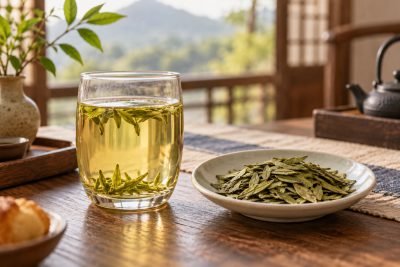
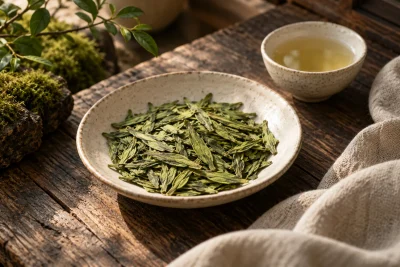
No in-house tasting or customer-photo reuse is claimed. The artwork is an editorial illustration, and the assessment bars are research-based judgments, not results of personal tasting.
Tea details
| Tea style | Dragon Well (Long Jing), green tea |
|---|---|
| Seller-stated origin | Qiantang District, Hangzhou, Zhejiang, China |
| Cultivar | Longjing #43 |
| Harvest date | 2026-04-15 |
| Cup method: leaf | 1.5 g |
| Cup method: water | 250 mL |
| Cup method: temperature | 85 °C / 185 °F |
| Cup method: time | 3–5 min (180–300 s) |
| Gongfu method: leaf | 4 g |
| Gongfu method: water | 110 mL |
| Gongfu method: temperature | 85 °C / 185 °F |
| Gongfu infusion sequence | 15, 25, 40, 60, 90 s, after rinse |
| Seller storage instructions | Airtight, opaque packaging; refrigerated (seller instructions) |
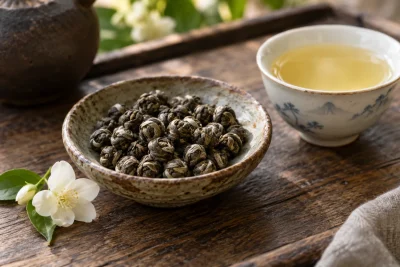
Jasmine Dragon Pearls Green Tea
Jasmine - Hengxian County, Nanning City, Guangxi Province Green Tea - Jinggu County, Puer City, Yunnan Province · 2026-04-13
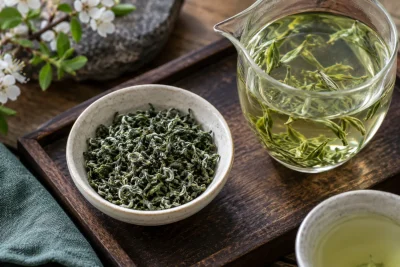
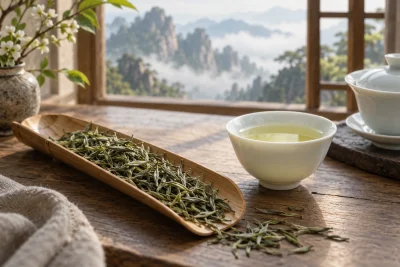
Huang Shan Mao Feng Green Tea
Da Guyun village, Shexian(歙县), Huangshan, Anhui Province · 2026-04-16