Check the exact names and locations
The Baozhong title uses Wen Shan, while the source table names Zhushan in Nantou and the Shan Lin Xi tea area. Tie Guan Yin names Anxi in Fujian. These are the seller’s exact declarations; the title alone is not independent geographic verification.
| Decision detail | Taiwan Wen Shan Baozhong (Pouchong) Oolong Tea | Tie Guan Yin Iron Goddess Oolong Tea |
|---|---|---|
| Seller-stated origin | Zhushan, Nantou, Taiwan; garden listed as Shan Lin Xi Tea Area | Anxi County, Quanzhou, Fujian, China |
| Cultivar | Qingxin / Chin Shin | Tieguanyin |
| Listed harvest | May 3, 2026 | May 18, 2026; season label says Autumn |
| Cup starting point | 3.5 g / 355 mL / 100°C (212°F) / 2–3 min | 5 g / 355 mL / 100°C (212°F) / 3–5 min |
| Gongfu starting point | 7 g / 110 mL / 100°C (212°F) | 7 g / 110 mL / 100°C (212°F) |
Leaf shape changes portioning, not a quality score
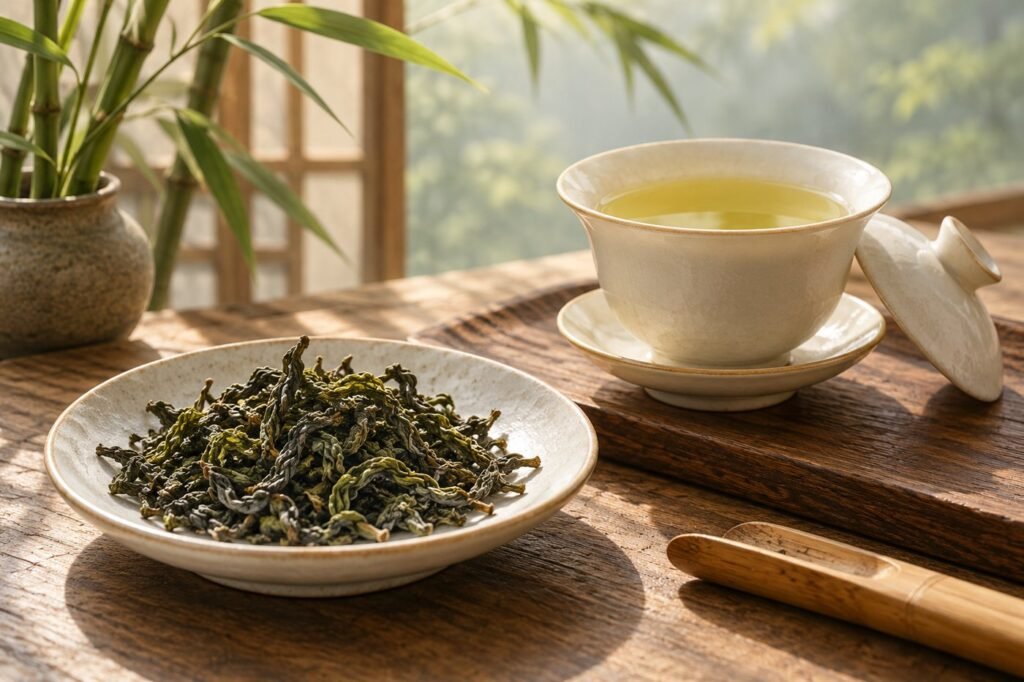
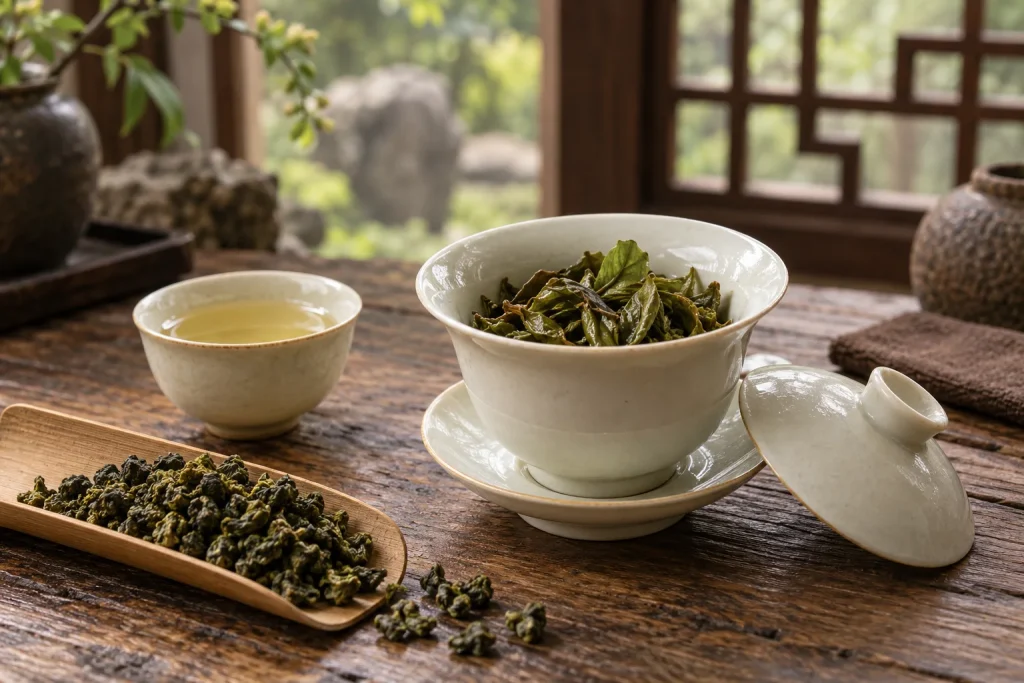
Baozhong’s curled strips occupy space differently from tightly rolled Tie Guan Yin. That is why a spoonful is a poor basis for comparing the two. Weigh the doses and begin with their separate recipes: the Baozhong cup uses less leaf and a shorter steep.
The small Baozhong read set describes a soft, sweet opening that can develop by the third infusion, with a slight peppery bitter note in one account. Tie Guan Yin has a broader historical sample with both aromatic praise and complaints about sourness, vegetation and fading. More available reviews do not prove that one tea is better; they simply reveal more disagreement.
A comparison that fits a small order
Try one measured cup of each, then reserve enough leaf to repeat the one you are less sure about. If Baozhong is too quiet, do not assume that doubling the dose will create Tie Guan Yin’s character. If Tie Guan Yin is too vegetal, the small Baozhong sample is an exploration, not a guaranteed cure.