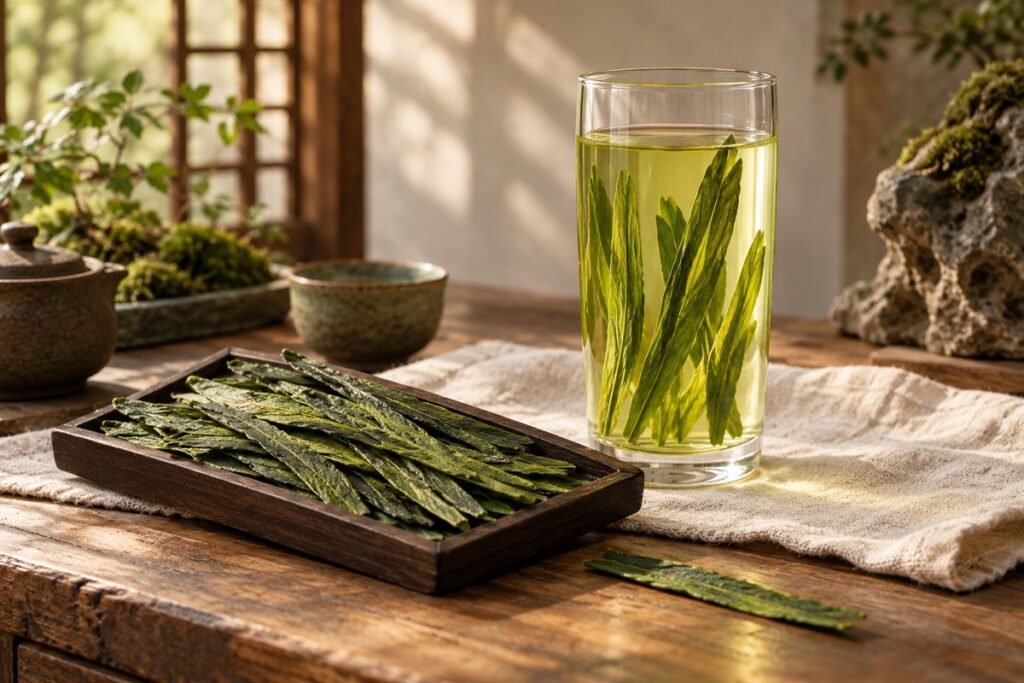
Grandpa-style brewing leaves the tea in the drinking vessel while you sip and add more water. Start with a modest amount of leaf, use a heatproof glass with room above the water, and refill before the remaining drink becomes too concentrated. If the cup turns unpleasant, strain it instead of forcing the method to work.
A glass method is different from a timed, decanted cup
With a removable infuser, you can stop leaf contact at a chosen time. With leaves left in the glass, extraction continues while you drink. That makes your drinking pace part of the recipe. A dose that works for a short gaiwan infusion is not a sensible automatic starting point for a glass that stays on the desk.
TeaVivre’s glass-brewing guide distinguishes water-first, split-pour and tea-first approaches. It places Tai Ping Hou Kui among the larger-leaf teas suited to adding the leaf first. The exact Hou Kui listing provides a separate cup starting point of 10–15 pieces, 250 mL and 85°C for one to three minutes. It does not establish an unlimited-infusion rule.
A first Hou Kui glass
- Choose a stable, heatproof vessel that comfortably holds 250 mL with headroom and leaves space for the long leaf. Do not fill a glass to the brim or use ordinary glassware without a hot-water rating.
- Begin at the low end of the merchant’s piece-count range: 10 pieces. This is a starting trial, not a verified gram conversion.
- Add a little 85°C water to wet the leaves, then bring the measured water total to 250 mL. Let the leaves open without crushing them into the glass.
- Taste cautiously after about a minute, once a small sip is comfortable. There is no need to drink dangerously hot tea to keep up with extraction.
- If you like the strength, sip at your own pace. As an editorial starting routine, refill when roughly half the liquid remains, using the same water temperature. Adjust the refill point to the taste.
- If it becomes dry or bitter, strain the liquid into another cup. Next time use fewer leaves or a timed infuser rather than assuming repeated top-ups will fix it.
Use what you notice to choose the next adjustment
| Problem | Useful change |
|---|---|
| Leaves interfere with drinking | Wait for them to settle or use a suitable strainer; do not force a mouthful through floating leaf. |
| Too strong before you finish the first glass | Reduce leaf next time or switch to a timed, decanted preparation. |
| Weak immediately after a refill | Allow more contact time before adding more water; record the refill amount. |
| Repeated refills lose their appeal | Finish the session and discard the spent leaf rather than chase a fixed infusion count. |
For a workday with frequent interruptions, a removable infuser may be the better tool. Choose the glass method when watching the leaves and making small adjustments is part of the pleasure. Prepare fresh leaf for a new session rather than treating wet leaves left on a desk as a permanent supply.