Smoky Lapsang Souchong review: choose it for the pine smoke
Smoky Lapsang is a deliberate flavor choice, not a neutral introduction to black tea.
We may earn a commission if you buy through our links. Affiliate disclosure.
At a Glance
KEY FEATURES
- Style: Smoky Lapsang
- Seller-stated origin: Tong Mu Guan (桐木关), Wuyi Mountain, Fujian Province, China
- Listed harvest: 2025-04-30
- Cup recipe: 3 g / 355 mL / 90°C / 194°F / 3–5 min
Tea assessment
Research-based editorial assessment for the uses described below, not personal tasting or hands-on testing. Scores are qualitative judgments out of 5, separate from customer stars; historical feedback may cover other harvests or variants.
Pine smoke and resin are the defining choice, with strong preference differences.
Some cups are mellow beneath the smoke; others are overwhelmed by it.
The documented cup is a useful first trial, but brewing cannot promise away a smoke aversion.
Enjoyable repeat brewing is reported; lingering equipment aroma is also a practical consideration.
PROS
- Distinctive pine-smoke character
- The cup can be softer than the aroma suggests
CONS
- Smoke can overpower the base tea
- The aroma can linger on teaware
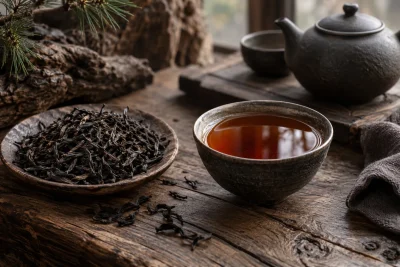
Pine-smoke and resinous impressions dominate the customer evidence. That can be exactly the attraction for an established smoked-tea drinker, while a reader hoping for only a faint smoky accent may find the base tea difficult to reach.
Smoke is the feature, not a small background note
The feedback ranges from a pleasing smoky aroma with a gentle cup underneath to a campfire-like intensity that overwhelms everything else. Those descriptions are not mutually exclusive evidence of quality: they show why knowing your preference for smoke matters more than a general star score.
Use the cup recipe to judge the style
A measured three-minute cup at the published ratio is a clearer first trial than a strong improvised brew. If the smoke itself is unpleasant, more tinkering may not be the right answer. The separately reviewed Wild Lapsang is a different listing and should not be treated as simply a weaker version of this smoked tea.
Smoky Lapsang: a measured first cup of pine smoke
Cup & infuser
3 g / 355 mL / 90°C / 194°F / 3–5 min. Begin at the lower end of the stated time range, then separate the leaves from the drink. Taste before changing one setting in the next cup.
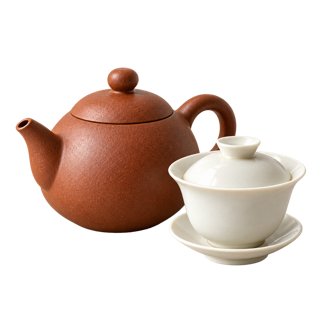
Gongfu & gaiwan
5 g / 110 mL / 90°C / 194°F. Rinse: indicated; duration not specified. Drinking infusions: 5 → 10 → 15 → 20 → 25 → 35 → 45 seconds. Pour off each infusion before the next.
Source: the exact merchant brewing instructions, checked October 3, 2026. These are starting recipes, not in-house test results.
Decide whether smoke belongs in your tea routine
| What matters to you | What to try or consider |
|---|---|
| You have never tried smoked tea | Start with a small quantity. Decide whether pine smoke is enjoyable before thinking about larger packs or daily use. |
| You want fruit rather than smoke | Look at Wild Lapsang as a separate style decision. A name shared across listings is not proof of the same processing or flavor. |
For a wider preparation or selection decision, use how to brew chinese black tea: cup and gongfu. The recipe here remains the starting point for this exact tea.
For storage, the merchant specifies: Store in airtight, opaque packaging; in cool, dry place.
Review basis: selected original customer feedback across harvests, combined with merchant documentation; no personal tasting or customer-consensus calculation.
Pros & Cons Analysis
Based on supplied customer reviews and verified product documentation
Pros
- A purposeful choice for smoked-tea enthusiasts. Positive feedback values the recognizable smoky and earthy direction. This is a specific drinking preference, not a universal advantage over unsmoked black tea.
- There may be tea beneath the smoke. The read set includes mellow, low-astringency cups and enjoyable repeat infusions. That gives an experienced smoke drinker a reason to sample it rather than equating a powerful aroma with inevitable harshness.
Cons
- A sample matters more than a grade label. Strong dislike and excessive-smoke impressions are prominent in the contrary evidence. If you want only a trace of smoke, this is a risky blind large purchase.
- Consider where you use it. An assessed experience describes a lingering smoky smell on the brewing equipment. That is not a controlled cleaning test, but it is a practical reason to notice how the aroma behaves in your own setup.
Buy Smoky Lapsang only for a smoke preference
Where Lapsang Souchong Smoky Black Tea fits
Buy Smoky Lapsang because you want a pine-smoked cup.
Before a larger purchase
Do not choose it merely because you want a strong black tea; intensity and smoke are different preferences.
Before a larger purchase
A small first order is particularly valuable here because the very feature enthusiasts enjoy is also the reason others reject it.
Frequently Asked Questions
What is the cup recipe for this tea?
3 g / 355 mL / 90°C / 194°F / 3–5 min. Use the current pack instructions if its identity differs.
Is this based on your own tasting?
No. It synthesizes original customer feedback and merchant documentation. The assessment bars are research-based suitability judgments, not personal tasting results.
How should I store it?
Store in airtight, opaque packaging; in cool, dry place. Follow the instructions supplied with your exact pack.
Tea details
| Tea style | Smoky Lapsang |
|---|---|
| Seller-stated origin | Tong Mu Guan (桐木关), Wuyi Mountain, Fujian Province, China |
| Cultivar | Wuyi Qi Cong Cultivar |
| Harvest date | 2025-04-30 |
| Cup method: leaf | 3 g |
| Cup method: water | 355 mL |
| Cup method: temperature | 90°C / 194°F |
| Cup method: time | 3–5 min |
| Gongfu method: leaf | 5 g |
| Gongfu method: water | 110 mL |
| Gongfu method: temperature | 90°C / 194°F |
| Gongfu infusion sequence | 5, 10, 15, 20, 25, 35, 45 s; rinse: indicated; duration not specified |
| Seller storage instructions | Store in airtight, opaque packaging; in cool, dry place |
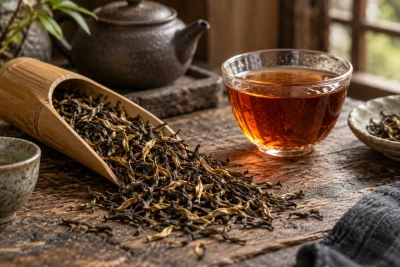
Yun Nan Dian Hong Black Tea Golden Tip
Lida Village, Desili, Mengyou Town, Fengqing County, Lincang City, Yunnan Province · 2026-04-08
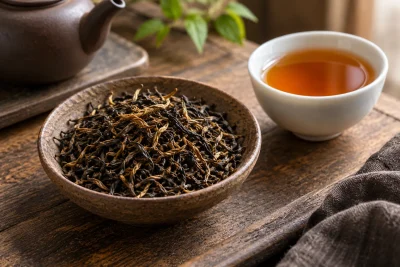
Premium Golden Monkey Black Tea
Fuding City, Fujian Province · 2026-05-18
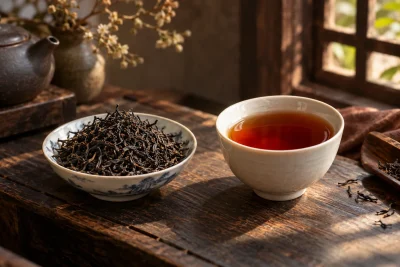
Premium Keemun Hao Ya Black Tea
Qimen County, Huangshan City, Anhui Province · 2026-06-16
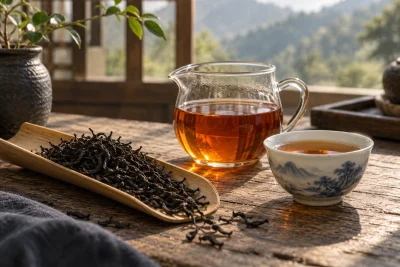
Lapsang Souchong Wild Black Tea
Wuyi Mountain, Fujian Province · 2026-04-23